As a psychotherapist, a big part of my job is seeing life through the eyes of others. This is absolutely essential if we are to accurately understand anyone’s thoughts, feelings and behaviors, yet it’s rarely something human beings do. Instead, we superimpose the framework of our own perspective onto other people and then try to make sense of them on that basis. While this is our natural default mode for orienting to the interpersonal world, it creates numerous misunderstandings because it introduces false premises; every interpretation following from those original erroneous assumptions will be flawed. An easy illustration of this is interacting with someone from a different cultural background wherein the same gesture has a different meaning. If a horizontal head shake means disagreement in my culture and agreement in theirs, and I just assume it means to them what it means to me, we’re going to have serious trouble communicating. Even if I understand their words, what I see them doing will throw me off. I’ll think they’re contradicting themselves–or me! I might even ascribe a nefarious motive, like they’re deliberately being evasive, obstinate or confusing. After all, if I were saying one thing and indicating the opposite with my body language, one of those would be my reason, so I take for granted it’s theirs.
This kind of thing happens in countless ways and pervades our interactions with others. Over time, if we’re paying attention and care about getting along, we learn to apply more appropriate heuristics in dealing with people who have become familiar to us. We gradually understand how and why they view things differently than we do, based on their distinctly different experiential history, situational context and personal priorities. When we’re out of sync, we no longer jump to the conclusion they’re “just being difficult,” and instead take into consideration how such factors obviously result in contrasting views. Taking the time to truly understand another person is inconvenient and can involve a lot of extra work, but the alternative is conflict and/or disconnection. We want and need harmonious, cooperative engagement with at least some other people, so the additional effort required is worthwhile. And, since we also want them to understand us, we could deem it fair or diplomatic to take the stance we’d like reciprocated in the form of mutual respect, curiosity and concern.
I don’t mean to give a lecture here on the social merits of empathic attunement. Rather, I want to set the stage for discussing a phenomenon that is readily understandable to us, but may be peculiar–perhaps even inscrutable–to our acquaintances. On a recent ride around one of my most oft-repeated local loops, I imagined an alien observing me from their spaceship, hidden within the clouds overhead. What could they possibly make of my behavior…?
This human hops on his mechanical transport device, but then doesn’t use it to get to another destination; he just travels right back to where he began. Not only is his movement ultimately pointless, but he frequently covers the same ground again and again. He accomplishes absolutely nothing, and does so without even introducing any novelty. What could drive such a wasteful expenditure of time and energy? He’s not trying to get somewhere. He’s not engaged in some form of exploration or discovery. He’s not collecting supplies. He’s not protecting or expanding his domain of control. He keeps repeating this wholly fruitless action, rather than doing something productive or beneficial–or even interesting! This human makes no sense.
This alien has never ridden a motorcycle, but one needn’t be from another galaxy to find the typical motorcyclist’s routine behavior baffling, maybe even ridiculous. Many of our fellow earthlings can’t imagine the appeal of what we do, or they imagine it inaccurately. I’m reminded of my first and only attendance at a NASCAR race. The deafening cacophony within Bristol Motor Speedway’s sweltering echo chamber made it impossible to hear the person screaming to me from the very next seat, regardless of what form of hearing protection I was or wasn’t wearing at the moment (I desperately tried every available option). The cars–which all looked identical to me except for their sponsors’ logos–kept tediously circulating the same featureless oval circuit for hours on end, most often in a fixed order. Yet the crowd was incredibly enthused, cheering vigorously and leaping to their feet in response to events utterly mysterious and undetectable to me. I’d been to many other racing events and had found them all quite exciting and easily understandable. But this iteration, despite its extreme simplicity (or because of it), left me totally bewildered. Even without the intolerably obnoxious din, how could this anti-spectacle possibly justify the expense of a ticket, the travel time to and from the track, and the two-plus hours required to simply get into or out of the facility grounds? It made less than zero sense to me. To the extent I could hear my own thoughts, I concluded the fans must have been heavily drugged and hypnotized into mass hysteria, like I’d have to be to act similarly. I apparently arrived too late for this essential crowd prep.
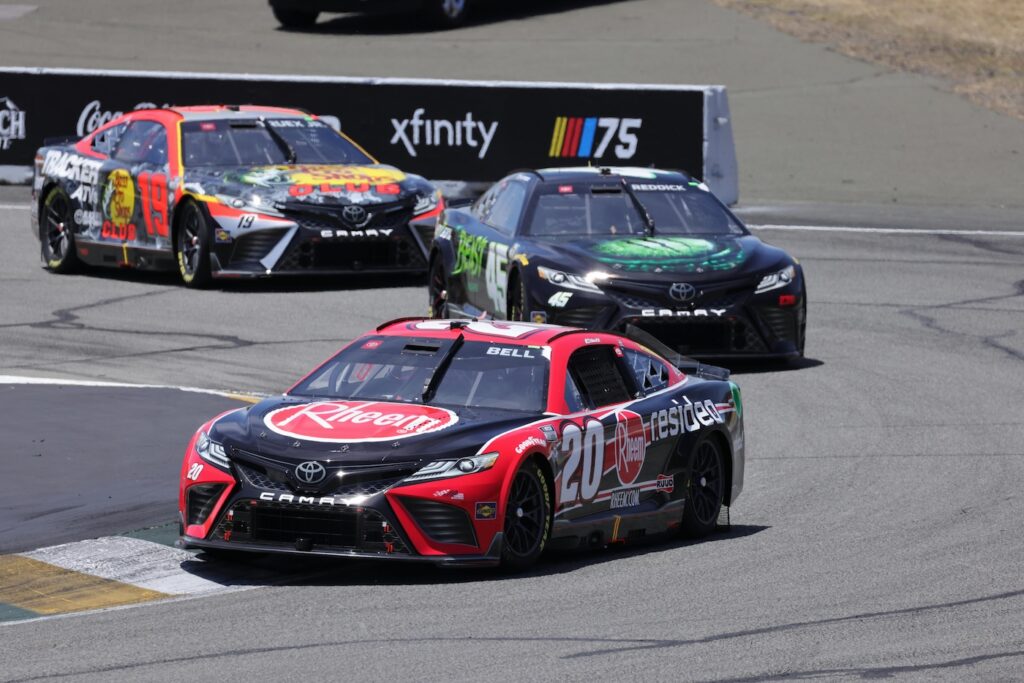
Those of you who are NASCAR fans realize I missed most of the show. Because I knew virtually nothing about the drivers, the teams, the cars or the strategies being employed, I might as well have been watching from a distant planet. I had no context, no depth of understanding that would have made what I was witnessing not only intelligible, but exhilarating. As someone who used to follow multiple motorcycle racing series very closely and tried to share this beloved activity with the uninitiated, I remember slamming against the wall of incomprehension and watching others in the room do the same. They couldn’t understand what they were seeing on the television screen with all the rich backstories and multidimensional nuances that were glaringly apparent to me. And I couldn’t understand how something so easily visible to me was so impossibly invisible to them, especially after I’d regaled them with dozens of elaborate explanations! For some races, I even made posterboard charts with all the riders, teams, track configurations (complete with corner numbers) and other relevant factors laid out in graphic form to help neophytes in the audience keep up. I cringe now, thinking back on those days. Surely, the folks who’d open-mindedly accepted my race-watch-party invitations in the early ‘90s had about as much fun as I had that night in Bristol. Sorry!!
To an outside observer, the enthusiast’s world is mostly, if not completely, obscure. What appears to be monotonously repetitive can actually be a continuous cavalcade of infinite variations, layered in endlessly new arrangements. The adage, “You can’t step in the same river twice.” applies. Yes, it is the same geographic feature you’ve encountered in the past, but its boundaries are constantly changing, even if the differences are imperceptible to your limited sensorium, and the water contacting your skin is perpetually being replaced. That’s before we get to anything like the fluctuations in depth, clarity and current speed due to recent rainfall or the influence of upstream dams. Considering it “the same river” requires ignoring, or being ignorant of, myriad dimensions in a relentless state of flux. It’s only the same on a map, not in real life–and so it is with our favorite riding loops.

The Ride Inside with Mark Barnes is brought to you by the MOA Foundation. You can join the BMW Motorcycle Owners of America quickly and easily to better take advantage of the Paul B. Grant and Clark Luster training reimbursement programs offered by the Foundation.
While my imaginary alien (or non-motorcycling neighbor) sees my trek across the same mountain backroads as perplexingly repetitive, they’re simply constrained by a limited and inaccurate mental model based on their own history, personality, preferences, etc. For them, maybe it really would be tiresome and meaningless–a total waste of time and effort, just like my experience of that NASCAR race. If they imagine me operating within the context of their worldview, my behavior is nonsensical, although maybe they’d make sense of it by attributing to me the characteristics and motives that would have to be in play for them to behave in like manner. They might conclude, for instance, I’m a terribly boring, inhibited, bovine creature who lacks any hint of creativity or sense of adventure, or I’m someone who takes refuge in familiarity to avoid challenge and eschew change. I probably also eat the exact same meals, day after day, and have never tried an ice cream flavor other than vanilla.
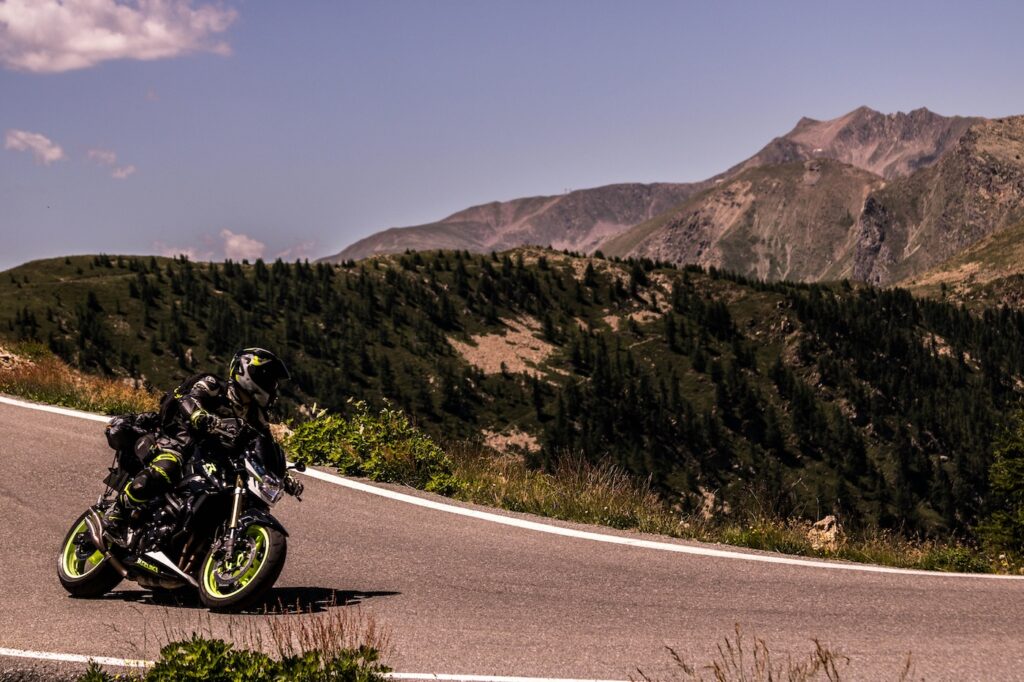
Although plenty of people no doubt find me boring, and I have certainly retreated into the comforts of familiarity during times of acute stress, what happens on one of my well-worn weekend loops is quite the opposite of this explanation. On such a ride, I’m keenly aware of a plethora of unexpected and unpredictable elements, and exposure to these novelties is one of the primary attractions. Even though I’ve traversed this sequence of curves hundreds of times before, it wasn’t at exactly this pace, or using exactly these lines, or in exactly this weather. My new tires and suspension settings alter the feel of this stretch of pavement, which also currently features a different amount of surface debris. The nearby vegetation has a specific look at this point in the season, and the cloudscape is unique. Traffic is unusually light or heavy–or somehow precisely average–and the percentage of other motorcycles in the mix is higher or lower. This combination of gear I’ve selected manages one end of today’s temperature range nicely, but doesn’t serve as well at the other end. My shifting isn’t as smoothly coordinated as usual, but my braking technique seems pretty good. Can I reproduce that wonderfully sensual succession of g-forces I just felt through the last corner? I’m focused now. Now I’m not as focused. Time to re-focus. Why are there so many critters at the edge of the woods through here? Better stay vigilant for deer. Are those storm clouds beginning to creep over that ridge? What’s the fastest way home from this location? Maybe a little rain would feel refreshing in the midst of today’s heat… Despite the fact I’m traveling the very same route that has comprised half my riding so far this year, nothing about it feels routine or repetitive. Of course I recognize the basic physical layout, but this is merely background–albeit the only aspect someone else might notice. In the foreground, I’m intensely interested in what’s emerging non-stop in my surroundings and my own internal processing.
Novelty, in the form of discovery or creativity, is a key ingredient of enjoyment. Think of a long-term relationship. While there can be much value in its consistency and reliability, it will get stale if the parties don’t continue to learn about each other and express themselves more and more fully and authentically. This is an active process, requiring dedication and initiative. Such learning involves risks on both sides, whether we’re doing the inquiring or the revealing, and the associated tension is part of what keeps us interested and invested; a bit of suspense seasons the recipe. Even if it were possible to know everything about the other person (it isn’t–not even close!), there’d be more to learn the next day because they’d have had new experiences, thoughts and feelings, and either grown or reaffirmed their position in response; the same would be true for us, too.
Likewise, any enduring activity must contain some element of surprise to remain engaging. Repetition can have its own special value when we need grounding and reassurance that we’re not drowning in chaos. We require novelty to keep the spark of vitality alive, and novelty’s beauty is in the eye of the beholder. Discovery is at least as much a function of our perspective and intentionality as it is a matter of external circumstances. Clearly, we can get a whopping dose of discovery by riding into parts unknown and hurling ourselves into completely unfamiliar situations. But a multitude of discoveries awaits us on even the most familiar ride, each and every time, if only we have the proper mindset.